
Early surgical treatment recommended for post traumatic Rotator cuff tears in the shoulder.
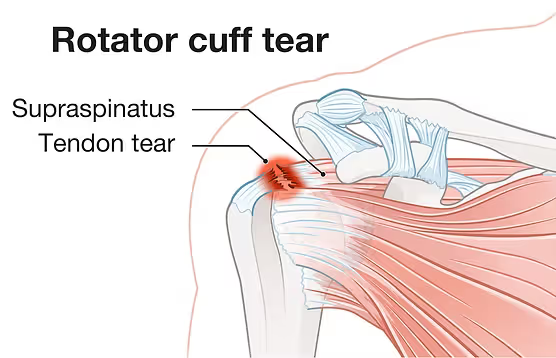
Discussion
Most rotator cuff tears of the shoulder are of degenerative in origin.
It is one of the common causes of shoulder pain. Milgrom et al (1995) found that the prevalence of partial- or full-thickness tears increased markedly after 50 years of age and it was over 50 percent of dominant shoulders in the seventh decade and in 80 percent of subjects over 80 years of age. They concluded that results indicate that rotator-cuff lesions are a natural correlate of ageing and are often present with no clinical symptoms.
Previous cadaveric studies have shown that the incidence of rotator cuff tears in normal population above the age of 50 was more than 30%.
The commonest complication of a shoulder dislocation in an adult above 40 is a rotator cuff tear. Wu at al (2026) found that patients over 40 had a 46% probability of developing a rotator cuff tear after dislocation, compared to 16.4% in patients under 40. Hence it is very difficult to find out whether a rotator cuff tear in someone 40 was caused by the injury or was pre-existent. Considering the high prevalence of degenerative cuff tears in the normal population, a significant number of tears fall into the acute on chronic group (asymptomatic long standing tears becoming symptomatic following an injury). Only a careful history, clinical examination and further imaging can identify these post traumatic tears. Examination of the opposite shoulder can give clues of any constitutional predisposition towards cuff degeneration and tears. If an MRI done in the early stages following an injury shows evidence of fatty infiltration of the rotator cuff muscles, degeneration of the cuff footprint, tendinopathy of the cuff in general etc. gives a clue that most likely the cuff tear was chronic. MRI finding of oedema, kinking, and muscular atrophy are positive criteria for differentiation but it should be used in conjunction with the history and clinical examination. Proximal migration of the humeral head in relation to the glenoid on a plain xray can be an indirect evidence of long standing cuff tear.
Relatively young age without history of previous shoulder symptoms, history of shoulder dislocation and clinical and radiological features of rotator cuff tears are most likely attributable to the injury. It should be remembered that symptoms from pre-existing cuff tears can be aggravated by recent trauma.
There is evidence in the literature that in rotator cuff tears, caused by injuries, the outcomes are better with an early operation. Gutman et al (2021) studied 206 patients who had sustained a traumatic rotator cuff tear with a mean age of 60 (mean follow up of 35.5 months) and concluded that there was a drop in function in patients who underwent surgery more than 4 months after injury. Peterson and Murphy (2011) studied 36 patients, for an average follow up of 35 months, and concluded that large post traumatic tears repaired after four months had the worst outcome. Duncan et al (2015) looked at 20 patients and found that improved outcomes were obtained if surgery was performed within 6 months. Patel et al (2021), studied 20 patients who had cuff repair within four months and found no significant difference in patient reported outcomes scores between the early and delayed repair. Liu et al (2024) studied a group of 87 patients with traumatic and non traumatic cuff tears. They subdivided the traumatic group into early and delayed repair with a follow up of 6 months. The study concluded that early repair (within 3 months) of traumatic rotator cuff tears yielded superior outcomes, including improved range of motion, lower pain symptoms, and lower risk of postoperative re-tears compared to delayed repair. Additionally, non-surgical treatment is recommended as the preferred approach for patients with non-traumatic RCI.
In summary, it can be concluded that early surgical treatment provides superior outcomes following a traumatic rotator cuff tear.
References
1. Keener JD, Patterson BM, Orvets N, Chamberlain AM. Degenerative Rotator Cuff Tears: Refining Surgical Indications Based on Natural History Data. J Am Acad Orthop Surg. 2019 Mar 1;27(5):156-165. doi: 10.5435/JAAOS-D-17-00480. PMID: 30335631; PMCID: PMC6389433.
2. Milgrom, C, Schaffler, M, Gilbert, S, van Holsbeeck, M. Rotator-Cuff Changes in Asymptomatic Adults: The Effect of Age, Hand Dominance and Gender. J Bone Joint Surg Br. 1995;77-B(2):296-298. Cited in: Journals@Ovid Full Text at https://ovidsp.ovid.com/ovidweb.cgi?T=JS&PAGE=reference&D=ovftb&NEWS=N&AN=00004624-199503000-00026. Accessed August 14, 2026.
3. Keyes, E. L. (1933). OBSERVATIONS ON RUPTURE OF THE SUPRASPINATUS TENDON BASED UPON A STUDY OF SEVENTY-THREE CADAVERS. Annals of Surgery, 97(6), 849–856. https://doi.org/10.1097/00000658-193306000-00007
4. Wu, K., Lv, G., Hu, A. et al. Development and validation of a risk prediction model for rotator cuff tears following acute anterior shoulder dislocation. BMC Musculoskelet Disord 27, 165 (2026). https://doi.org/10.1186/s12891-026-09550-1
5. Loew, M., Magosch, P., Lichtenberg, S., Habermeyer, P., & Porschke, F. (2015). How to discriminate between acute traumatic and chronic degenerative rotator cuff lesions: an analysis of specific criteria on radiography and magnetic resonance imaging. Journal of Shoulder and Elbow Surgery, 24(11), 1685–1693. https://doi.org/10.1016/j.jse.2015.06.005
6. Gutman, M. J., Joyce, C. D., Patel, M. S., Kirsch, J. M., Gutman, B. S., Abboud, J. A., Namdari, S., & Ramsey, M. L. (2021). Early repair of traumatic rotator cuff tears improves functional outcomes. Journal of Shoulder and Elbow Surgery, 30(11), 2475–2483. https://doi.org/10.1016/j.jse.2021.03.134
7. Petersen SA, Murphy TP. The timing of rotator cuff repair for the restoration of function. J Shoulder Elbow Surg 2011;20:62-8. https:// doi.org/10.1016/j.jse.2010.04.045
8. Duncan NS, Booker SJ, Gooding BWT, Geoghegan J, Wallace WA, Manning PA. Surgery within 6 months of an acute rotator cuff tear significantly improves outcome. J Shoulder Elbow Surg 2015;24: 1876-80. https://doi.org/10.1016/j.jse.2015.05.043
9. Liu, A., Zhang, B., Lai, T., Wang, M., Wu, G., Liu, S., & Zhang, T. (2024). Comparison of functional outcomes following early and delayed arthroscopic repair for traumatic and non-traumatic rotator cuff injuries. Journal of Orthopaedic Surgery and Research, 19(1), Article 368. https://doi.org/10.1186/s13018-024-04858-x